
Essential Roofing Terms You Should Know
Roofing 101: A Guide to Key Roofing Terms With Visual Guides
Getting a new roof or even repairing a roof isn't something that happens every day. The odds are it's just not something that you generally think about At Central Roofing and Siding Co. we pride ourselves on being among the most knowledgeable and respected home improvement contractors in Maryland and Washington D.C. Below you will find a list of common roofing terms and definitions along with some drawings to help you get a little more familiar with your roof.
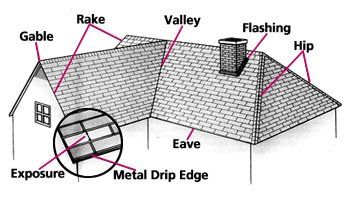
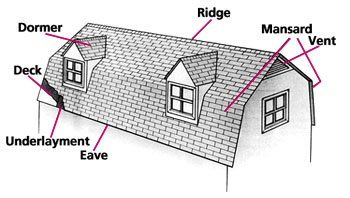
- Algae discoloration: A type of roof discoloration caused by algae. Commonly called fungus growth.
- Asphalt: A bituminous waterproofing agent applied to roofing materials during manufacturing.
- Asphalt plastic roofing cement: An asphalt-based cement used to bond roofing materials. Also known as flashing cement or mastic; should conform to ASTM D-4586.
- Back Surfacing: Fine mineral matter applied to the back side of shingles to keep them from sticking.
- Base flashing: That portion of the flashing attached to or resting on the deck to direct the flow of water onto the roof covering.
- Blisters: Bubbles that may appear on the surface of asphalt roofing after installation.
- Built-up roof: A flat or low-sloped roof consisting of multiple layers of asphalt and ply sheets.
- Bundle: A package of shingles. There are 3, 4 or 5 bundles per square.
- Butt edge: The lower edge of the shingle tabs.
- Caulk: To fill a joint with mastic or asphalt cement to prevent leaks.
- Chalk line: A line made on the roof by snapping a taut string or cord dusted with chalk. Used for alignment purposes.
- Class "A": The highest fire-resistance rating for roofing as per ASTM E-108. Indicates roofing is able to withstand severe exposure to fire originating from sources outside the building.
- Class "B": Fire-resistance rating that indicates roofing materials are able to withstand moderate exposure to fire originating from sources outside the building.
- Class "C": Fire-resistance rating that indicates roofing materials are able to withstand light exposure to fire originating from sources outside the building.
- Closed cut valley: A method of valley treatment in which shingles from one side of the valley extend across the valley while shingles from the other side are trimmed two inches from the valley centerline. The valley flashing is not exposed.
- Coating: A layer of viscous asphalt applied to the base material into which granules or other surfacing is embedded.
- Collar: Pre-formed flange placed over a vent pipe to seal the roof around the vent pipe opening. Also called a vent sleeve.
- Concealed nail method: Application of roll roofing in which all nails are driven into the underlying course of roofing and covered by a cemented, overlapping course. Nails are not exposed to the weather.
- Condensation: The change of water from vapor to liquid when warm, moisture-laden air comes in contact with a cold surface.
- Counter flashing: That portion of the flashing attached to a vertical surface to prevent water from migrating behind the base flashing.
- Course: A row of shingles or roll roofing running the length of the roof.
- Coverage: Amount of weather protection provided by the roofing material. Depends on number of layers of material between the exposed surface of the roofing and the deck; i.e., single coverage, double coverage, etc.
- Deck: The surface installed over the supporting framing members to which the roofing is applied.
- Dormer: A framed window unit projecting through the sloping plane of a roof.
- Downspout: A pipe for draining water from roof gutters. Also called a leader.
- Drip edge: A non-corrosive, non-staining material used along the eaves and rakes to allow water run-off to drip clear of underlying construction.
- Eaves: The horizontal, lower edge of a sloped roof.
- Eaves flashing: Additional layer of roofing material applied at the eaves to help prevent damage from water back-up.
- Edging strips: Boards nailed along eaves and rakes after cutting back existing wood shingles to provide secure edges for reroofing with asphalt shingles.
- Ell: An extension of a building at right angles to its length.
- Felt: Fibrous material saturated with asphalt and used as an underlayment or sheathing paper.
- Fiber glass mat: An asphalt roofing base material manufactured from glass fibers.
- Flashing: Pieces of metal or roll roofing used to prevent seepage of water into a building around any intersection or projection in a roof such as vent pipes, chimneys, adjoining walls, dormers and valleys. Galvanized metal flashing should be minimum 26-gauge.
- Flashing Cement: See asphalt plastic roofing cement.
- Gable: The upper portion of a sidewall that comes to a triangular point at the ridge of a sloping roof.
- Gable roof: A type of roof containing sloping planes of the same pitch on each side of the ridge. Contains a gable at each end.
- Gambrel roof: A type of roof containing two sloping planes of different pitch on each side of the ridge. The lower plane has a steeper slope than the upper. Contains a gable at each end.
- Gutter: The trough that channels water from the eaves to the downspouts.
- Head lap: Shortest distance from the butt edge of an overlapping shingle to the upper edge of a shingle in the second course below. The triple coverage portion of the top lap of strip shingles.
- Hip: The inclined external angle formed by the intersection of two sloping roof planes. Runs from the ridge to the eaves.
- Hip roof: A type of roof containing sloping planes of the same pitch on each of four sides. Contains no gables.
- Hip shingles: Shingles used to cover the inclined external angle formed by the intersection of two sloping roof planes.
- Ice dam: Condition formed at the lower roof edge by the thawing and re-freezing of melted snow on the overhang. Can force water up and under shingles, causing leaks.
- Interlocking shingles: Individual shingles that mechanically fasten to each other to provide wind resistance.
- Laminated shingles: Strip shingles containing more than one layer of tabs to create extra thickness. Also called three-dimensional shingles.
- Lap: To cover the surface of one shingle or roll with another.
- Mansard roof: A type of roof containing two sloping planes of different pitch on each of four sides. The lower plane has a much steeper pitch than the upper, often approaching vertical. Contains no gables.
- Nesting: A method of reroofing with new asphalt shingles over old shingles in which the top edge of the new shingle is butted against the bottom edge of the existing shingle tab.
- Normal slope application: Method of installing asphalt shingles on roof slopes between 4 inches and 21 inches per foot.
- Open valley: Method of valley construction in which shingles on both sides of the valley are trimmed along a chalk line snapped on each side of the valley. Shingles do not extend across the valley. Valley flashing is exposed.
- Organic felt: An asphalt roofing base material manufactured from cellulose fibers.
- Overhang: That portion of the roof structure that extends beyond the exterior walls of a building.
- Pallets: Wooden platforms used for storing and shipping bundles of shingles.
- Pitch: The degree of roof incline expressed as the ratio of the rise, in feet, to the span, in feet.
- Plastic Cement: A compound used to seal flashings and in some cases to seal down shingles as well as for other small waterproofing jobs. Where plastic cement is required for sealing down shingles, use a dab about the size of a quarter unless otherwise specified.
- Ply: The number of layers of roofing: i.e. one-ply, two-ply.
- Quick-setting cement: An asphalt-based cement used to adhere tabs of strip shingles to the course below. Also used to adhere roll roofing laps applied by the concealed nail method.
- Rafter: The supporting framing member immediately beneath the deck, sloping from the ridge to the wall plate.
- Rake: The inclined edge of a sloped roof over a wall from the eave to the ridge.
- Release tape: A plastic or paper strip that is applied to the back of self-sealing shingles. This strip prevents the shingles from sticking together in the bundles, and need not be removed for application.
- Ridge: The uppermost, horizontal external angle formed by the intersection of two sloping roof planes.
- Ridge shingles: Shingles used to cover the horizontal external angle formed by the intersection of two sloping roof planes.
- Rise: The vertical distance from the eaves line to the ridge.
- Roofing tape: An asphalt-saturated tape used with asphalt cements for flashing and patching asphalt roofing.
- Run: The horizontal distance from the eaves to a point directly under the ridge. One half the span.
- Saturated felt: An asphalt-impregnated felt used as an underlayment between the deck and the roofing material.
- Self-sealing shingles: Shingles containing factory-applied strips or spots of self-sealing adhesive.
- Self-sealing strip or spot: Factory-applied adhesive that bonds shingle courses together when exposed to the heat of the sun after application.
- Shading: Slight differences in shingle color that may occur as a result of normal manufacturing operations.
- Sheathing: Exterior grade boards used as a roof deck material.
- Single coverage: Asphalt roofing that provides one layer of roofing material over the deck.
- Slope: The degree of roof incline expressed as the ratio of the rise, in inches, to the run, in feet.
- Soffit: The finished underside of the eaves.
- Soil stack: A vent pipe that penetrates the roof.
- Span: The horizontal distance from eaves to eaves.
- Specialty eaves flashing membrane: A self-adhering, waterproofing shingle underlayment designed to protect against water infiltration due to ice dams or wind driven rain.
- Square: A unit of roof measure covering 100 square feet.
- Starter strip: Asphalt roofing applied at the eaves that provides protection by filling in the spaces under the cutouts and joints of the first course of shingles.
- Steep slope application: Method of installing asphalt shingles on roof slopes greater than 21 inches per foot.
- Step flashing: Flashing application method used where a vertical surface meets a sloping roof plane.
- Strip shingles: Asphalt shingles that are approximately three times as long as they are wide.
- Tab: The exposed portion of strip shingles defined by cutouts.
- Telegraphing: A shingle distortion that may arise when a new roof is applied over an uneven surface.
- Three-tab shingle: The most popular type of asphalt shingle usually 12" x 36" in size with three tabs.
- Top lap: That portion of the roofing covered by the succeeding course after installation.
- UL label: Label displayed on packaging to indicate the level of fire and/or wind resistance of asphalt roofing.
- Underlayment:A layer of asphalt saturated (sometimes referred to as tar paper) which is laid down on a bare deck before shingles are installed to provide additional protection for the deck.
- Valley: The internal angle formed by the intersection of two sloping roof planes to provide water runoff.
- Vapor retarder: Any material used to prevent the passage of water vapor.
- Vent: Any outlet for air that protrudes through the roof deck such as a pipe or stack. Any device installed on the roof, gable or soffit for the purpose of ventilating the underside of the roof deck.
- Woven Valley: Method of valley construction in which shingles from both sides of the valley extend across the valley and are woven together by overlapping alternate courses as they are applied. The valley flashing is not exposed.